
Kerr County Traffic Warrants Follow Courts
A traffic citation can remain a pending court case even when a person cannot find it through one online search. A missed date or unpaid balance may lead the issuing judge to take further action, including a capias or warrant. The court record controls the exact status and next step.
In Kerr County, a city ticket, a JP citation, and a county-court case use different clerks. Identify the court printed on the citation before deciding where to check or pay.
One Citation Does Not Search Every Court
Kerrville Municipal Court handles citations issued under city jurisdiction. Ingram Municipal Court handles its own Class C cases. JP1, JP2, JP3, and JP4 keep separate precinct dockets. The County Clerk and District Clerk cover different county criminal matters. A search result from one office cannot establish that all other courts have no case.
Use the court name, citation number, and issue date from the paper notice. If those are unavailable, a clerk can often route a question using the person's name and date of birth. Ask whether a separate warrant or only a balance appears.
How to Check a Kerr County Citation
For a Kerrville citation, the municipal portal accepts a citation number with date of birth; driver's license, state, and date of birth; Social Security number with date of birth; license plate and state; first and last name with date of birth; or business name. The portal is for that city's court records.
A new Kerrville citation may take one to two business days to appear. If it is missing after that window, contact the court at 830-257-2388. For a JP citation, call the precinct shown on the notice. Ingram's clerk can explain its court options by phone at 830-367-5115.
- Search the named issuing court using the citation or case number.
- Call that court if the ticket is recent or the status is unclear.
- Ask whether a warrant, capias, or only a balance appears.
- Confirm payment processing and recall timing before relying on a cleared result.
DPS Does Not Run a Warrant Search
The DPS/OmniBase process concerns failure-to-appear or failure-to-pay reporting for license renewal. DPS directs people to the court that reported the citation and says its license staff cannot provide warrant status. A court warrant is a separate judicial order.
After the court reports compliance, the DPS record may take three to seven days to update. First confirm the case disposition with the issuing court; then ask DPS about a separate license hold. Do not use one status to infer the other.
What the Traffic Record Shows
Kerrville's monthly active list displays the listed person's name, warrant number, issue date, balance, offense, and update date. The balance can include fees. A portal payment screen and a warrant roster serve different purposes, so check both the court case and any separate warrant status.
For other courts, records may show a cause number, offense description, hearing entry, and amount due. Ask the clerk to explain whether a docket notation reflects an active order or an older event.
| Warrant / Citation Number | Use the identifier in the issuing court's own record. |
|---|---|
| Charge / Offense | Connects the entry to the underlying citation. |
| Issuing Court | Determines the file location and recall authority. |
| Balance | May include collection and warrant fees; ask for a current total. |
| Status | Ask the court whether it remains active or was recalled. |
Kerrville Updates Its List Monthly
Kerrville says its active warrant list is updated monthly. A listing may therefore be older than a recent payment or court action. The court's page also warns that after-hours payments may not post until the next business day. A warrant can remain active until staff process payment and the court recalls it.
The court's published warrant charge includes a $50 warrant fee and $10 OmniBase fee, in addition to possible collection charges. Ask the clerk for the current itemized amount. Do not rely on an old PDF or a payment receipt alone as confirmation that an order is cleared.
Kerrville publishes its warrant list and resolution information.
Paying Does Not Confirm Recall
Ask the issuing court which options apply: payment, a new setting, a bond, or a motion. A clerk can explain accepted methods and whether a judge must take a separate action. Keep the receipt and later verify the docket or list reflects the result.
Kerrville permits a voluntary weekday visit to discuss a city warrant under its own no-arrest policy. That local policy does not cover an Ingram, JP, County Court, or District Court case. If arrest is possible, get legal advice before going to an office.
- Confirm the exact amount and options with the issuing clerk.
- Use only the payment or appearance route the court accepts.
- Keep receipts, filed motions, and appearance notices.
- Ask the clerk to confirm recall and any separate hold release.
Warning: A payment confirmation is not necessarily a recall order. Contact the issuing court to verify the warrant status before relying on a cleared balance.
JP Precincts Keep Separate Traffic Files
Justice of the Peace courts process citations by precinct. JP3 publishes a failure-to-attend docket link and its own payment instructions; its clerk can confirm whether a missed setting produced an order. JP1, JP2, and JP4 use their own contacts and payment codes. Do not send a JP3 payment to another precinct.
The citation or case lookup should identify the correct office. If the paper only names a county precinct, use the court directory to locate its phone and current address. Each judge controls the case before that court.
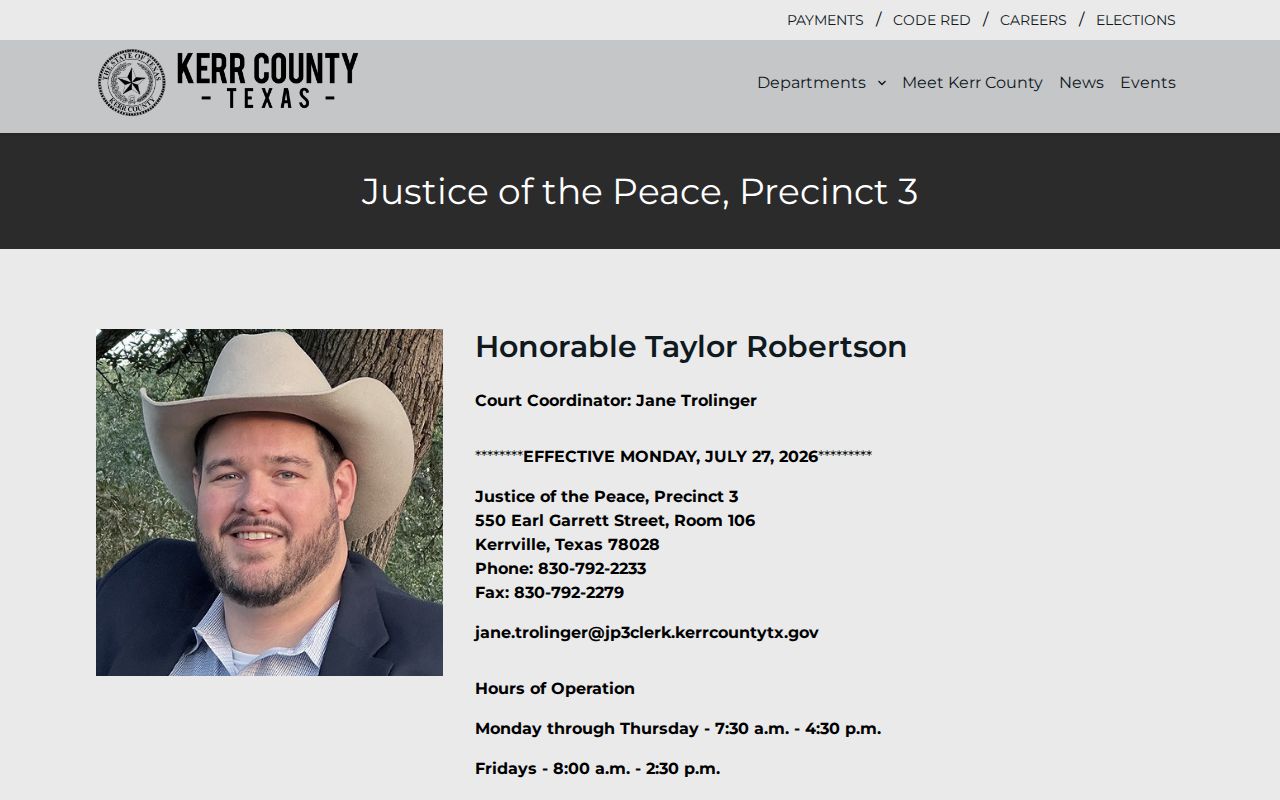
JP3's official page lists its court contact and docket materials.
Ingram Keeps Citation Payments Local
For an Ingram ticket, use the municipal clerk's own payment routes: mail, the counter, the drop box, phone extension 4, or FastGovPay. The city offers payment plans. Its late charge is $25 per case after 30 days, so request an itemized total before choosing a plan.
The payment vendor is not a county warrant search. Call the court to ask whether the case has an active order, what the judge requires, and when the docket will show any action.
Traffic Warrant vs FTA and License Holds
A court warrant is an order from the issuing judge. A failure-to-appear or failure-to-pay status in the DPS/OmniBase process concerns citation compliance and license renewal. A reported hold is not itself proof of an active arrest warrant, and a warrant search does not establish whether a license hold remains.
DPS directs people to the court that reported the citation and says its staff cannot provide warrant information. Updates may take three to seven days after the court reports compliance. Confirm the court disposition first, then follow up on any separate DPS record.
Ingram Municipal Court offers payment plans and publishes a $25-per-case late charge after 30 days. Those city terms differ from Kerrville's warrant list and from JP payment rules.
| Mechanism | What Triggers It | What It Does |
|---|---|---|
| Traffic warrant | Court issues an order | Authorizes arrest under that order |
| Failure to appear (FTA) | Missed a scheduled setting | Can lead to a separate court action |
| License / registration hold | Reported citation noncompliance | May affect renewal through the state process |